

Better team decisions through quantum thinking
We brought |HOP⟩, our quantum-physics game, to the Serious Play Conference in Europe to explore how teams really decide under uncertainty — successes, friction, and all.
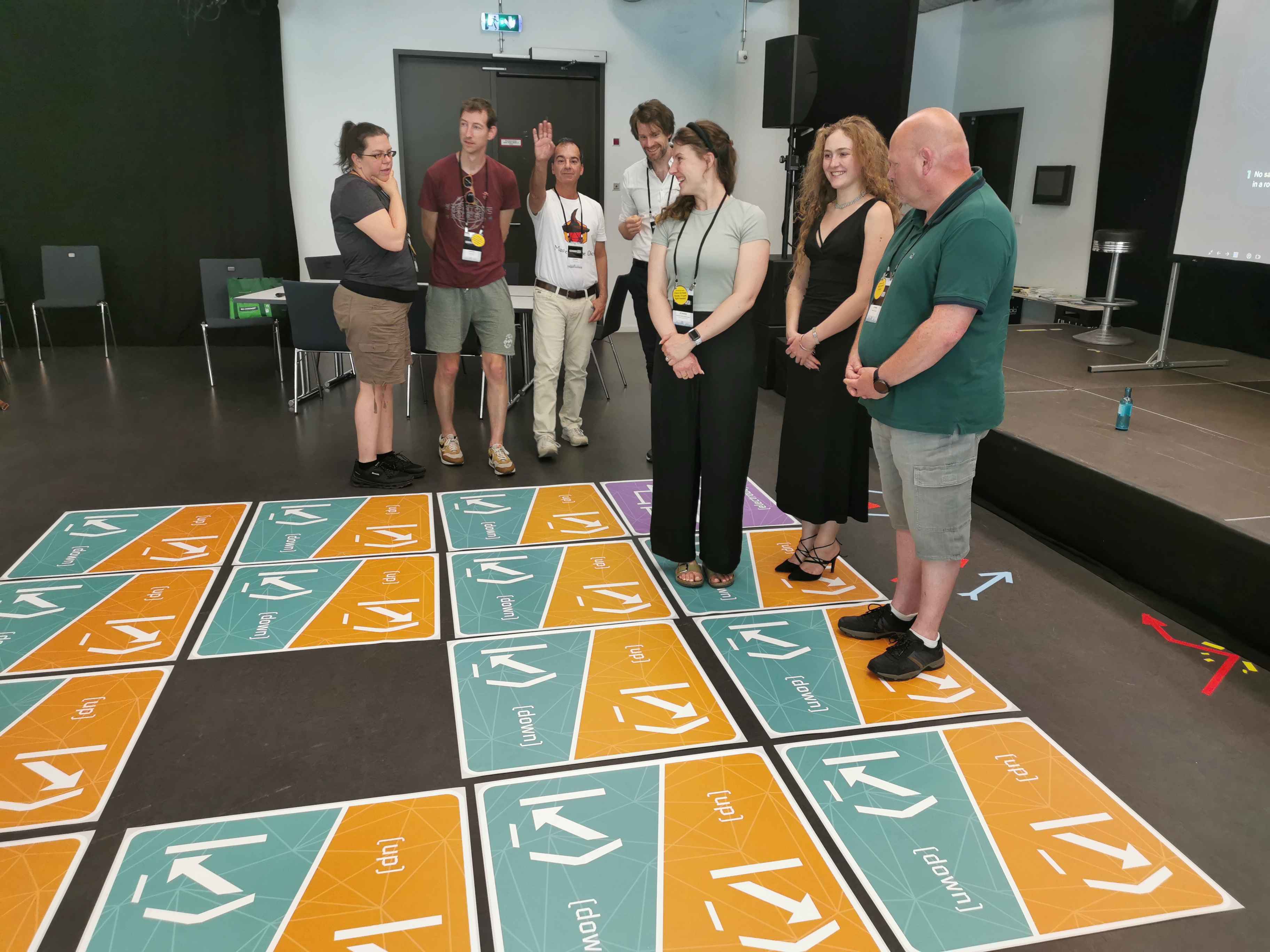
Quantum physics challenges one of our deepest assumptions: that reality is fixed, predictable, and linear. Business runs on the same illusion. We want certainty — clear roles, stable markets, rational decisions — while uncertainty, interdependence, and ambiguity quietly define most of our work.
On 19 June we brought that tension to the Serious Play Conference Europe with a one-hour workshop: Better team decisions through quantum thinking. Our instrument was |HOP⟩, a game originally designed to explore quantum physics — and, it turns out, a surprisingly sharp lens on how teams actually decide.
A game as a thinking space
|HOP⟩ turns quantum behaviour into something you can walk across. Players become electrons crossing a floor grid of spin tiles — each marked [up] or [down] — trying to reach the [electrode] together.
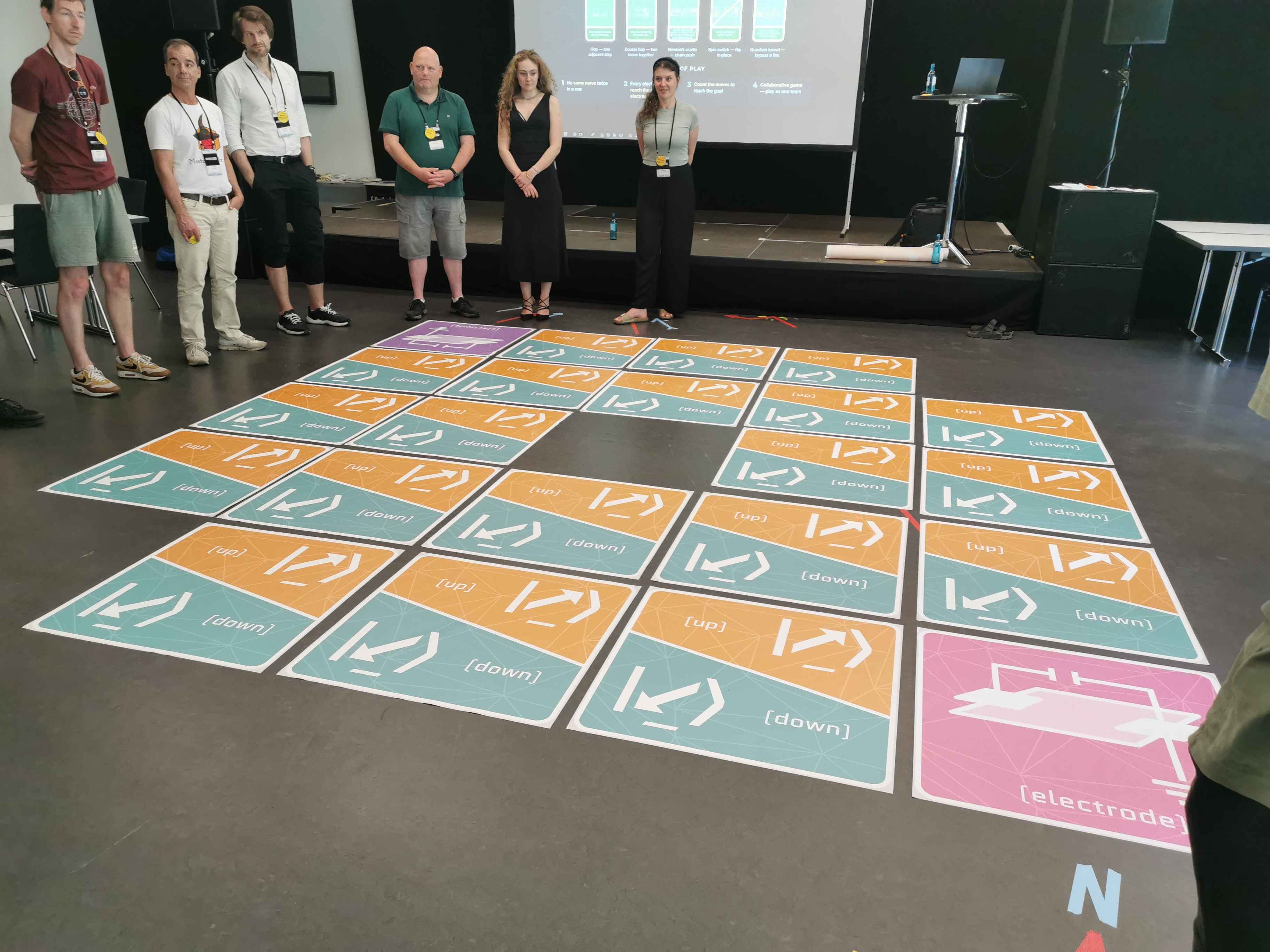
Motion follows five simple movements — here they are, straight from the game:
Hop
Move one electron to an adjacent site, keeping its spin.
Doublon Hop
Move a pair of electrons sharing a site to an empty adjacent site.
Spin Flip
Swap a single electron's spin in place, when the target spin is free.
Quantum Newton's Cradle
Hop toward a line of same-spin electrons; the one at the far end hops away.
Quantum Tunnel
Bypass a line of same-spin electrons and land on the first free site beyond.
And a few constraints that change everything: you can’t repeat the same move twice in a row, every electron has to reach the electrode, and — crucially — it’s collaborative. You win, or lose, as one team.
From quantum concepts to team reality
Underneath the play, participants meet four ideas and translate them, live, into the language of their own teams:
- Superposition → holding several options open instead of collapsing to a decision too early
- Uncertainty → acting well without complete information
- Entanglement → how one person’s choice instantly reshapes everyone else’s
- The observer effect → how the act of measuring — or watching — changes the outcome
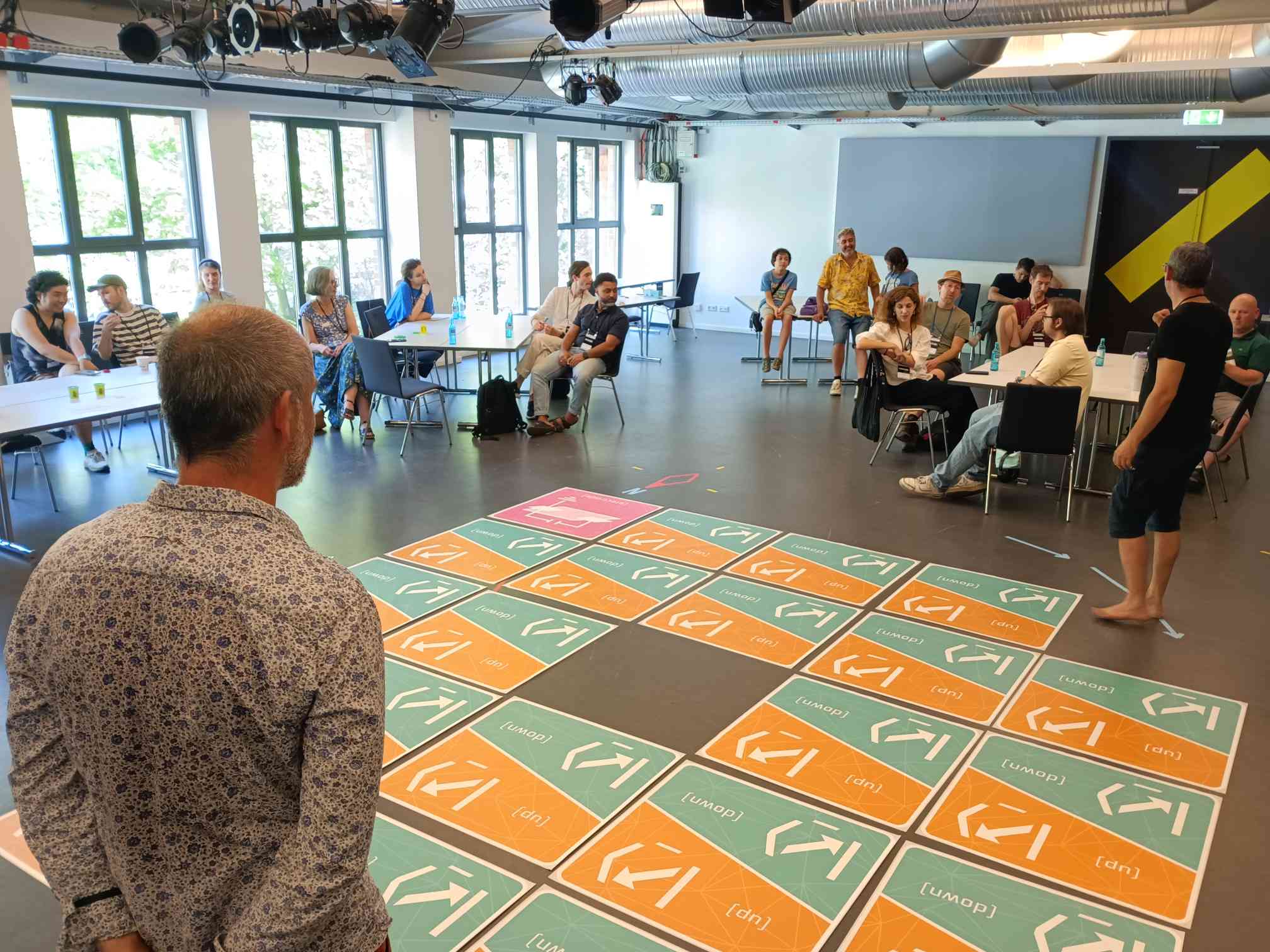
Those map, almost uncomfortably well, onto alignment, responsibility, market dynamics, and collective choice.
The honest part
This session isn’t a theory lecture. It’s grounded in real facilitation with teams and leaders navigating complexity and distributed decision-making — so we shared the friction as well as the breakthroughs. Playful metaphors can unlock a room, but they can also meet resistance before they click. Naming both is part of the method.
What people left with
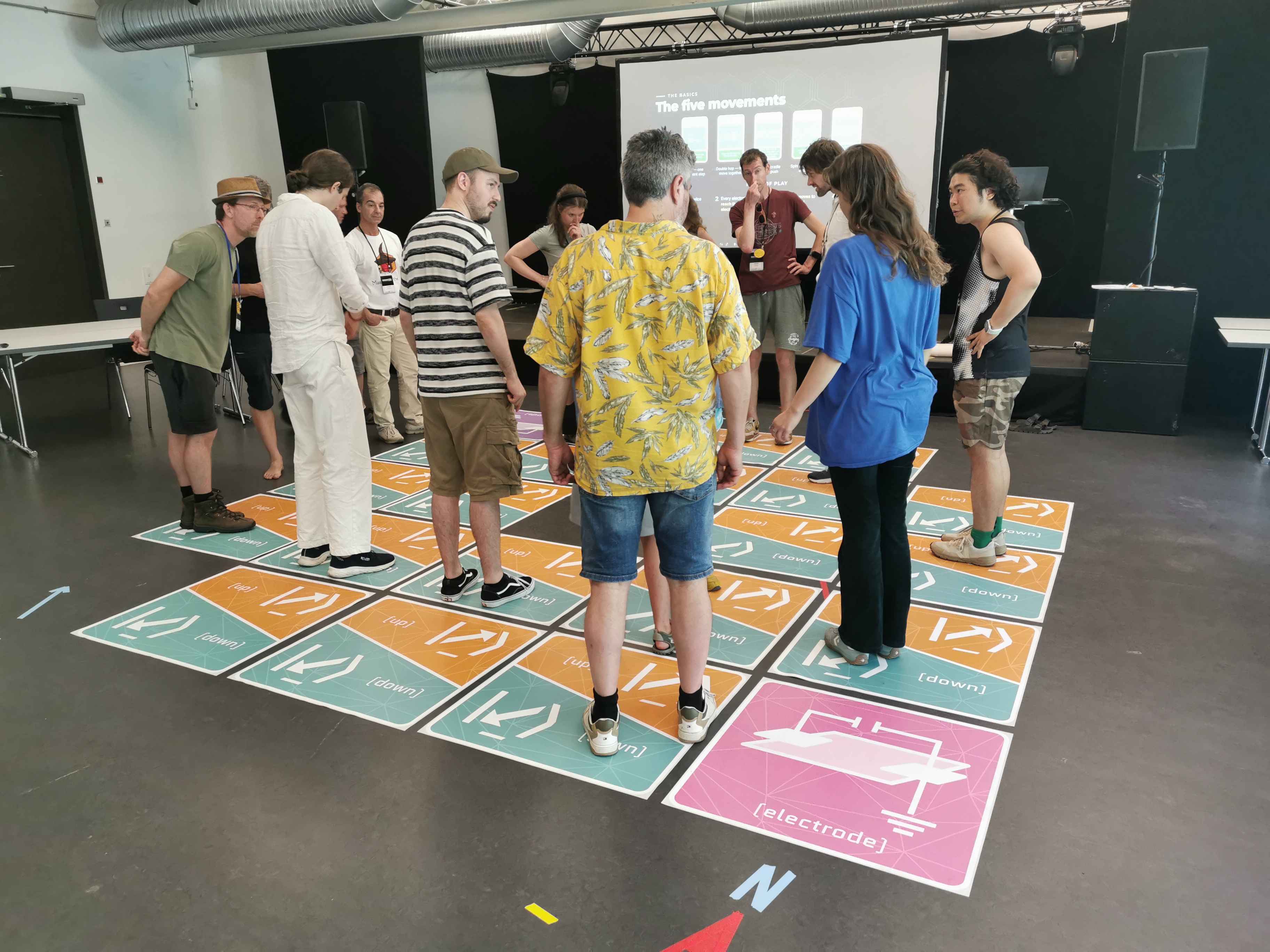
Beyond the experience itself, participants took home practical tools: facilitation patterns for moving a team from confusion to alignment, and debriefing techniques for turning individual perspectives into shared clarity.
The goal was never to teach quantum physics. It was to give teams a felt experience of deciding together under uncertainty — and a vocabulary to talk about it afterwards.
With thanks
|HOP⟩ is designed by Daniel Larose at La rose des Jeux. The workshop was facilitated by Yann Gensollen and Cédric Pontet of Playful Learner. Our thanks to the Serious Play community for playing along — and for challenging their own assumptions about how teams really decide.
Bring it to your team
What we ran at the conference was a one-hour taster. The full |HOP⟩ experience is a half-day (4-hour) or full-day (8-hour) workshop, built around the real decisions your team is facing — from strategic tension to distributed, high-stakes choices.
Curious how the game actually works? We break down every movement, the energy system, and the quantum physics behind them in a dedicated post.